
“Killer Apps” for a Ceiling DC Power Platform
Sponsor: Armstrong World Industries, Inc.
AC/D...J?
Team #1
Course #: EDSGN 100
Section #: 004
Submitted to:
Mr. John Klinger and Armstrong
Date: 30 April 2010
From Left to Right: Ashley Hoenigke(Email: alh5344@psu.edu), Camila Proffitt (Email: cjp5187@psu.edu), Janelle Stine (Email: jes5502@psu.edu), David Turocy (Email: drt5066@psu.edu)
1.0 Abstract
Our "Killer App." for Armstrong is the Gettyburg Addressor public address system. This P.A. system is unique, because it connects to Armstrong's 24V power grid and is controlled through a PC. Our Product also contains a smoke detector for convenient fire safety. Our P.A. System is more secure than others on the market, because of is voice recognition software. P.A. Systems are used in many commercial buildings (our main focus was on schools) and this is why it is the "Killer App." that we developed.
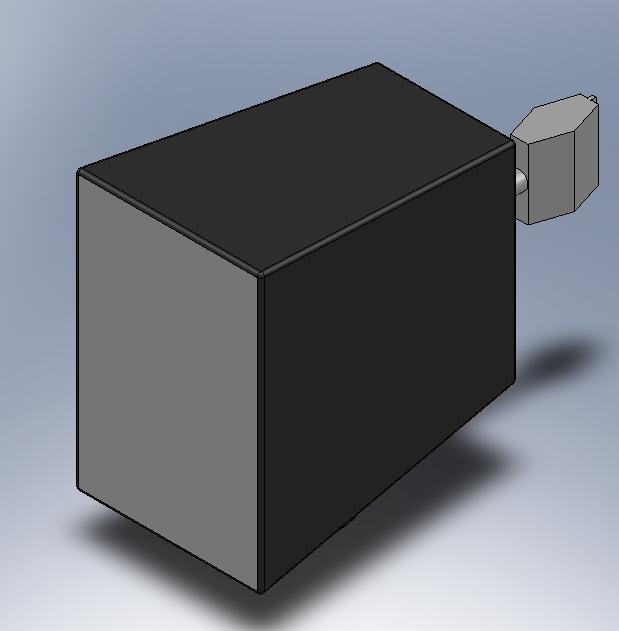
Figure 1: CAD Image
2.0 Introduction
Armstrong World Industries, Inc. has developed a new and innovative power supply system that is contained in the ceiling. This system supplies 24V DC and 100W to each rail in the suspended ceiling. Our task was to develop a realistic and innovative application or product that could utilize this ceiling.
We began to think about building that contained a drop ceiling. The building that we could think of the most applications for was a school building; particularly a high school. By looking at the project website, the FAQs, and the project requirements we began to develop our problem statement, mission statement, and customer needs.
3.0 Problem StatementDesign and develop a creative and innovative product for a particular commercial building that must run on 24 volts of DC power and 100 watts.
We derived our mission statement through what was asked of us from Armstrong. They needed new apps for new DC powered drop down ceilings and we needed to come up with an idea that meets the requirements such as weight and voltage.Here a link to our Mission Statement.
4.0 Customer Needs Analysis
To evaluate the importance of and thoroughly understand our customer needs we reviewed multiple sources. We first looked at the project website and found the basic requirements. Other question were answered on the FAQ section of the website.
Table 1: Customer Needs
| No. | Need | Imp | |
| 1 | The P.A. System | is safe | 5 |
| 2 | The P.A. System | is innovative | 4 |
| 3 | The P.A. System | runs on low voltage | 5 |
| 4 | The P.A. System | has commercial applications | 5 |
| 5 | The P.A. System | must be based off of known technology | 4 |
| 6 | The P.A. System | must be manufactured in short term | 3 |
| 7 | The P.A. System | must be environmentally friendly | 3 |
| 8 | The P.A. System | is secure | 4 |
| 9 | The P.A. System | is audible | 5 |
| 10 | The P.A. System | is easy to use | 4 |
| 11 | The P.A. System | is wireless | 3 |
| 12 | The P.A. System | is lightweight |
4 |
5.0 External Research
The external research consisted of customer needs analysis, selecting a type of building, and patent research. Our customer needs were determined from the requirements of the design that Armstrong gave us and from FAQ’s on Armstrong’s Design Project website. We then chose the type building we wanted our product to be used in, which was a school and most likely a classroom in particular. Once we had an idea in mind of what our “killer app.” was going to be, we researched similar products and patents to go along with them.
We also researched how an AC to DC transformer works. First, approximately 110V enter the primary coil of the transformer. This coil is wrapped around an iron core which contains the magnetic flux. The secondary coil contains less turns that the primary coil in this instance, and thus the Induced voltage is reduced by the ratio of the turns in the primary coil:the secondary coil. This current is still AC and must be rectified. This is done with multiple diodes and the result is pulsating DC current.
6.0 Target Specifications
For target specifications, we came up with ten metrics. The two most important metrics to the customers were that the PA system was safe and easy to install and use and the loudness. For this reason, we came up with a wireless PA system with a smoke detector and speakers that are between 60- 80 dB. It was also important that the PA system used existing technology in a new way. When looking at patents, we found a similar PA system called Bellcommander. The software used for The Gettysburg Addressor will be based off of the software used in Bellcommander. We also made sure that our PA system ran on 24 Volts so it will be compatible with the Armstrong ceiling. Another requirement was that the design must take between 2-5 years to complete. The Gettysburg Addresser will be complete within that time frame. Another important factor was that limited people can gain access to this PA system. So, we came up with a PA system with voice recognition. This also goes with safety and security. It is important that The Gettysburg Addresser isn’t too heavy, so the weight will be between 16- 32 pounds. Also, The Gettysburg Addresser can be used in schools, hospitals, and many retail stores. Lastly, since The Gettysburg Addresser is made out of plastic, it is recyclable. From these metrics we came up with a wireless, black with mesh PA system that also has voice recognition, a smoke detector and a desk top microphone.
Table 2: Target Specifications
| Metric No. | Metric | Imp | Units | Marginal Value | Ideal Value |
| 1 | Safe and easy to install and use | 5 | Subjective | >8 | 10 |
| 2 | Use existing tech. in a new way | 4 | Subjective | >8 | 10 |
| 3 | Measure Voltage | 4 | Volts | 24 | 24 |
| 4 | Usage in variety of buildings | 3 | Integer | >1 | >5 |
| 5 | Projected length of manufacturing time | 4 | years | <5 | <2 |
| 6 | Potentially recyclable | 1 | Y/N | N | Y |
| 7 | Number of people able to gain unauthorized access. | 4 | Integer | 5 | 0 |
| 8 | Loudness | 5 | dB. | 60 | 80 |
| 9 | Functions wirelessly | 3 | Y/N | N | Y |
| 10 | Weight | 4 | lbs. | <32 | <16 |
7.0 Concept Generation
For our concept generation step we needed to list all of our ideas to make this the best app and out of all of our ideas come up with the most beneficial one. We mainly used a morphology chart for our generation and our columns consisted of features, security, aesthetics, wireless capability, type of microphone. Overall we decided the concept with voice recognition, smoke detector, black with mesh protector, wireless, and desktop microphone best fulfilled the requirements for most efficient/cost effective product.
Figure 2a: EMS Model
Below our EMS model is shown. It was developed by thinking about our problem and translating it onto paper. The dashed lines are signal lines; The solid lines are energy lines.
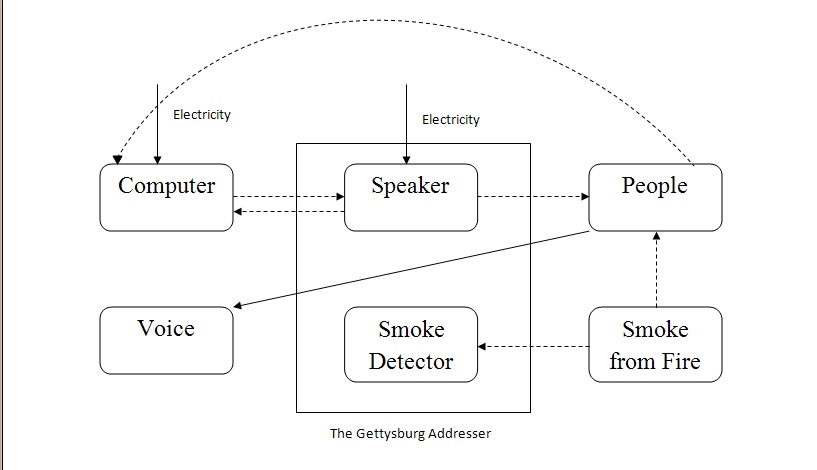
Figure 2b: Mind Map
Our mind map is show below. This web was useful in organizing idea (in the squares) and interconnecting them with lines and short phrases. The mind map helped to develop the morphology chart.
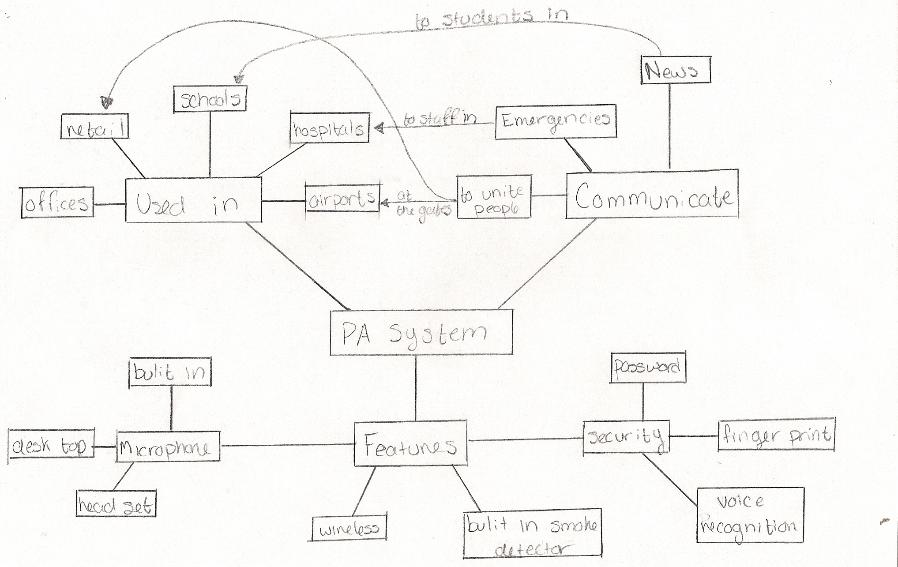
Table 3: Morphology Chart
| Function | |||||
| Means | Microphone | Security | Aesthetics | Feature | Connection |
| 1 | built in to the computer | password protection | various bright colors | smoke detector | wired |
| 2 | desk top microphone | voice recognition access | white plastic | none | wireless |
| 3 | head set | fingerprint | black speaker with mesh protector | ||
8.0 Concept Selection
A concept screening matrix was used to compare and contrast all eight concepts. After ranking the eight concepts, we chose the four highest ranked to continue and be the potential new design. Drawings were then created of each of the four concepts. Ultimately concept one was the one we chose to use in our final design.
Table 4: Concepts
| Concept | ||||||
| 1 | 2 | 3 | 4 | 5 | 6 | |
| Description | desk top mic | built in | head set | desk top mic | head set | built in |
| voice recognition | voice recognition | fingerprint | fingerprint | password | password | |
| black with mesh | black with mesh | black with mesh | white plastic | various colors | white plastic | |
| smoke detector | smoke detector | none | smoke detector | none | none | |
| wireless | wireless | wired | wireless | wired | wired | |
Table 5: Concept Screening Matrix
| Concept Variants | ||||||
| Selection Criteria | 1 | 2 | 3 | 4 | 5 | 6 |
| Entertainment/aesthetically pleasing | + | + | + | - | + | - |
| Wireless | + | + | - | + | - | - |
| Loudness | 0 | 0 | 0 | 0 | 0 | 0 |
| Secure | + | + | + | - | - | - |
| Cost | - | - | - | + | + | + |
| Weight | 0 | 0 | 0 | 0 | 0 | 0 |
| Power consumption | - | - | + | - | + | + |
| PLUSES | 3 | 3 | 3 | 2 | 3 | 2 |
| SAMES | 2 | 2 | 2 | 2 | 2 | 2 |
| MINUSES | 2 | 2 | 2 | 3 | 2 | 3 |
| NET | 1 | 1 | 1 | -1 | 1 | -1 |
| RANK | 1 | 1 | 1 | 2 | 1 | 2 |
| CONTINUE? | y | y | y | n | y | n |
| - = WORSE | ||||||
| 0 = SAME | ||||||
| + = BETTER | ||||||
Figure 3: Concepts
Concept 1
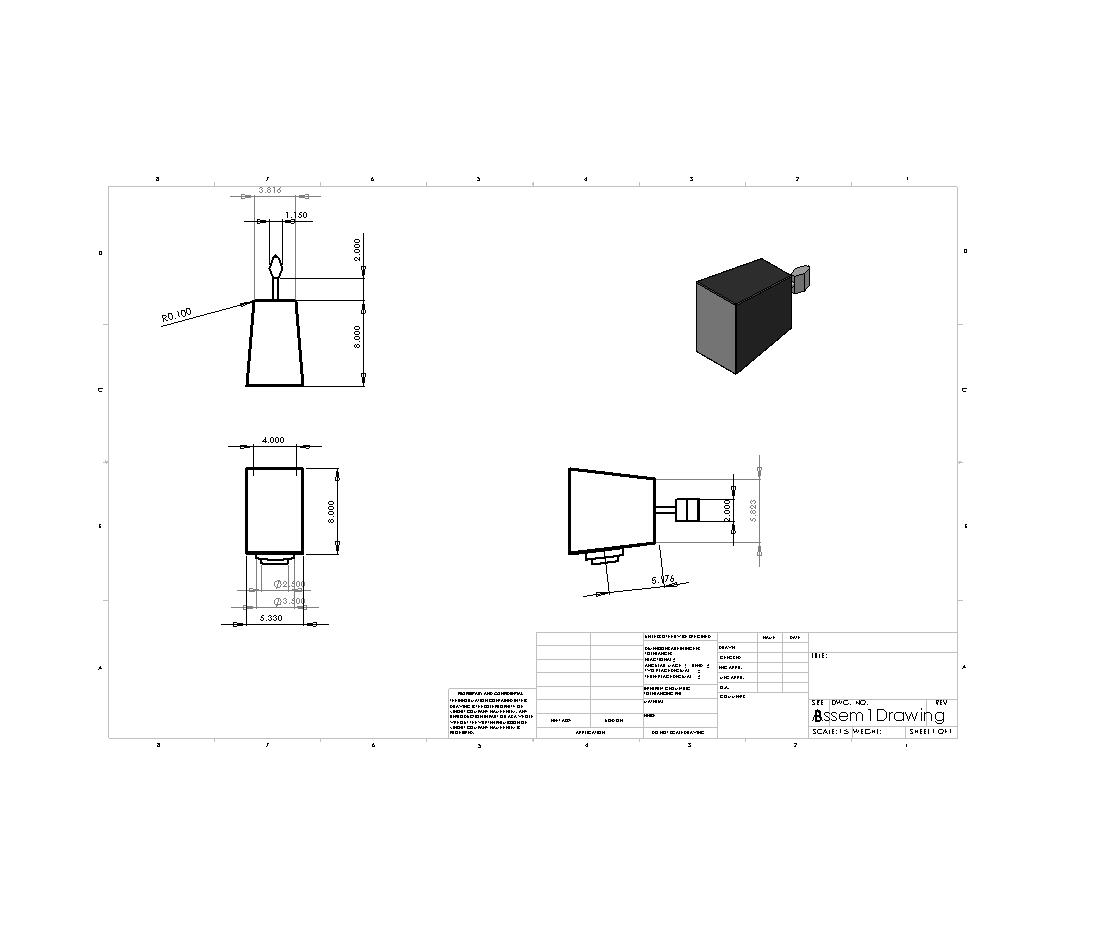
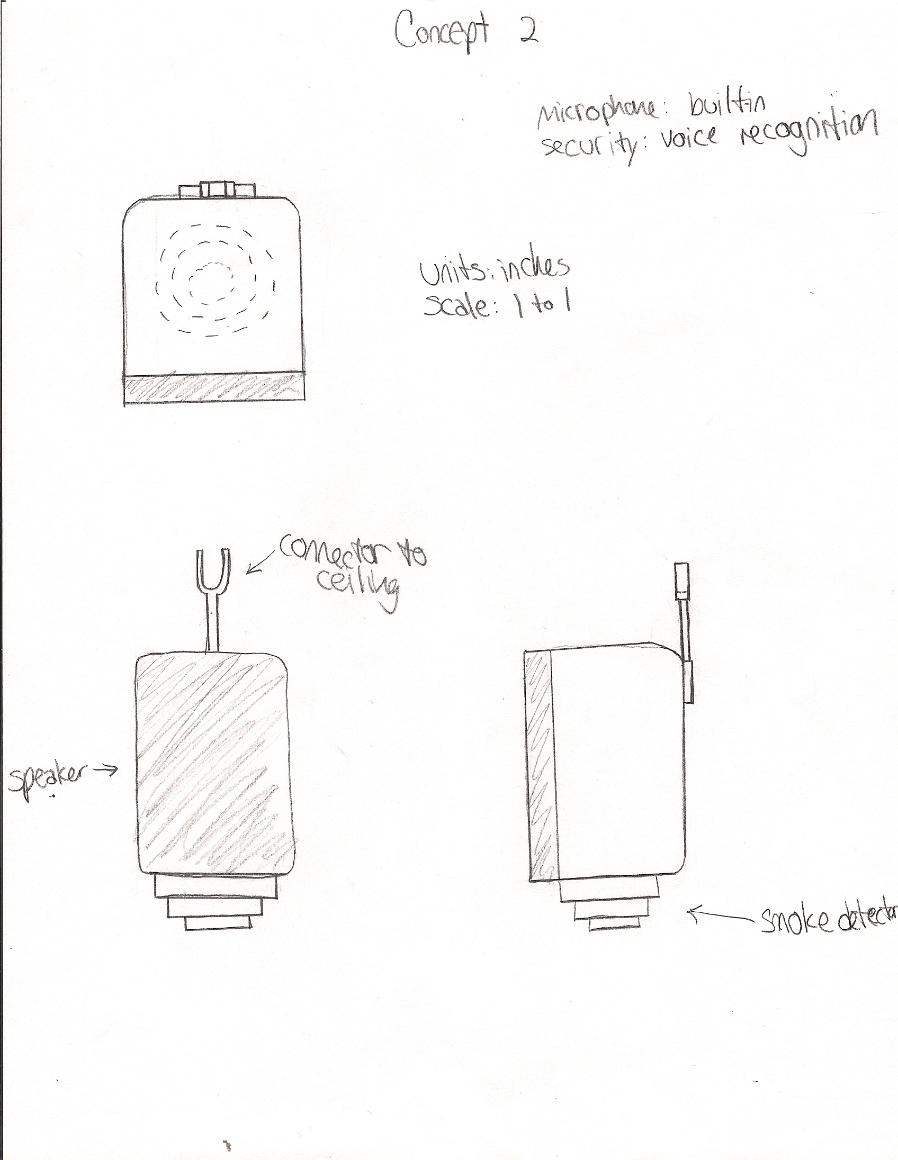
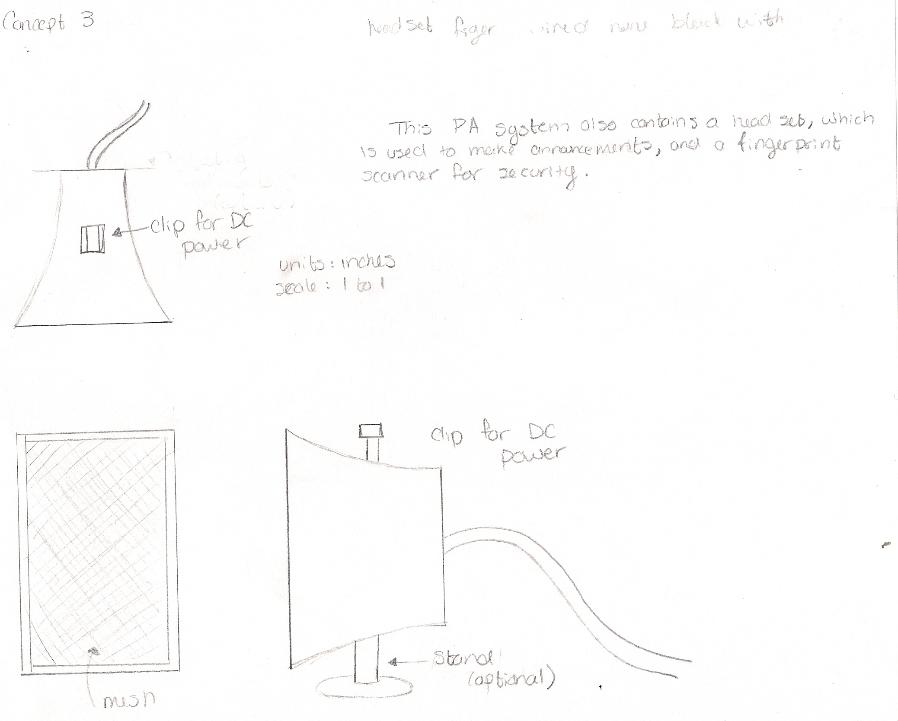
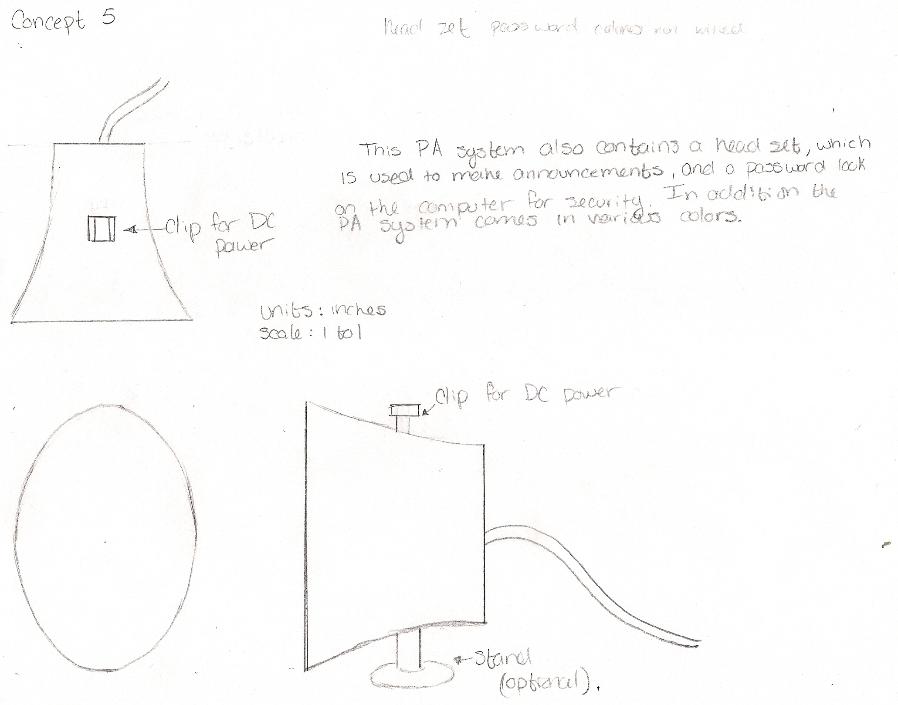
Table 6: Concept Selection
| Selection Criteria | Weight | Concept 1 | Concept 2 | Concept 3 | Concept 5 | ||||||||
| Rating | Value | Score | Rating | Value | Score | Rating | Value | Score | Rating | Value | Score | ||
| Safe and easy to install and use | 14% | 8 | 8 | 1.12 | 8 | 8 | 1.12 | 3 | 3 | 0.42 | 3 | 3 | 0.42 |
| Use existing tech. in a new way | 11% | 7 | 7 | 0.77 | 7 | 7 | 0.77 | 5 | 5 | 0.55 | 3 | 3 | 0.33 |
| Measure Voltage | 11% | 10 | 24 V | 1.1 | 10 | 24 V | 1.1 | 10 | 24 V | 1.1 | 10 | 24 V | 1.1 |
| Usage in variety of buildings | 8% | 10 | 5 | 0.8 | 10 | 5 | 0.8 | 6 | 3 | 0.48 | 6 | 3 | 0.48 |
| Projected length of manufacturing time | 11% | 5 | 2 | 0.55 | 5 | 2 | 0.55 | 8 | 1 | 0.88 | 8 | 1 | 0.88 |
| Potentially recyclable | 1% | 5 | n | 0.05 | 5 | n | 0.05 | 5 | n | 0.05 | 10 | y | 0.1 |
| Number of people able to gain unauthorized access. | 11% | 6 | 2 | 0.66 | 6 | 2 | 0.66 | 10 | 0 | 1.1 | 2 | 5 | 0.22 |
| Loudness | 14% | 8 | 80 | 1.12 | 7 | 75 | 0.98 | 8 | 80 | 1.12 | 8 | 80 | 1.12 |
| Functions wirelessly | 8% | 9 | y | 0.72 | 9 | y | 0.72 | 2 | n | 0.16 | 2 | n | 0.16 |
| Weight | 11% | 6 | 6 | 0.66 | 7 | 5 | 0.77 | 8 | 3 | 0.88 | 8 | 3 | 0.88 |
| Total | 100% | ||||||||||||
| Total Score | 7.55 | 7.52 | 6.74 | 5.69 | |||||||||
| Rank | 1 | 2 | 3 | 4 | |||||||||
| Rating | |||||||||||||
| Much worse | 1 | ||||||||||||
| Worse | 2 | ||||||||||||
| Neutral | 3 | ||||||||||||
| Better | 4 | ||||||||||||
| Much better | 5 | ||||||||||||
9.0 Final Specification
Final Specification where developed using our target specifications in conjunction with our final concept description.
| Metric | Units | Final Specification |
| Safe and easy to install and use | Subjective | 8 |
| Use existing tech. in a new way | Subjective | 7 |
| Measure Voltage | Volts | 24 |
| Usage in variety of buildings | Integer | 5 |
| Projected length of manufacturing time | years | 2 |
| Potentially recyclable | Y/N | N |
| Number of people able to gain unauthorized access. | Integer | 2 |
| Loudness | dB. | 80 |
| Functions wirelessly | Y/N | Y |
| Weight | lbs. | 6 |
For our final design we chose concept 1. This includes the black casing with mesh protector for our aesthetics because we thought this looks the most sleek. Also we have a fire detector as our safety feature because it's cost effective as opposed to something like security cameras and it enhances the product. For security we have voice recognition which we thought would be cheaper than the fingerprint reader yet more secure than a regular password. These speakers are synced wirelessly to a computer software. We found a PA system software during our research called Bell Commander. Any speaker company (ex: Bose) and Bell Commander could partner up to make this product possible. Each speaker of the PA system would use 15 watts at most, this was determined by researching the amperage draw of the speaker and smoke detector and using the equation P=VI. P=(24V)*(.5+.125)=15W
Our product utilizes the easy to use locking connecter from Armstrong for the power supply. The connector for the grid comes out of the back of the product can be easily adjusted to any angle of choice. The connector delivers the DC current to both the fire detector and the speaker. This product meets the requirements of running on 24V and is able to use in 2-5 years. It also created a new innovative way to enhance PA systems today with Armstrong's grid technology.
The final cost of our product will be approximately $130 for the basic package which includes the software, microphone, and one speaker (with smoke detector). Each additional speaker will cost $20 plus installation fees. These values were obtained by researching the prices of the Bellcommander system along the average prices of speakers and smoke detectors.
Figure 4: Final Design
The two photos below are an image and drawing (with dimensions) of our CAD model that accurately describes our product.
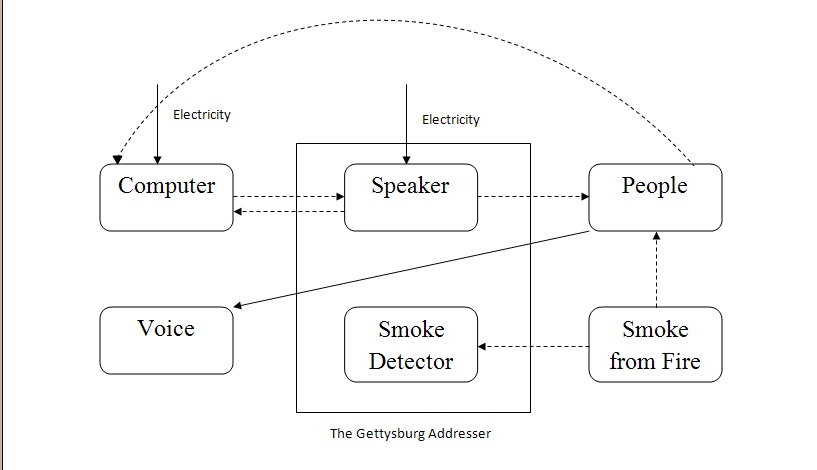
Figure 5: Final EMS Model
Below our Final EMS model is shown. It shows the people-people and smoke-people communication issues being solved by the Gettysburg addresser (in the box). It also shows the basics of how the final design will work.
11.0 Conclusions
For the design of our "Killer App.," we strictly followed the steps laid out in the design process. We started by coming up with customer needs through their website and Armstrong FAQs and followed the steps in this report chronologically. Our product's main selling points are its safety and security. The voice recognition feature enables school administrators to greatly reduce the risk of hackers. The fact that the smoke detector is built into our speaker is convenient for installation purposes. Installing the Gettysburg Addressor not only allows easy and secure communication, but functions as a fire alarm system as well.
12.0 ReferencesBrain, Marshall. "HowStuffWorks "A DC Current Transformer"." Howstuffworks "Science". N.p., n.d. Web. 28 Apr. 2010. http://science.howstuffworks.com/inside-transformer2.htm.
"Facsimile store and forward system ... - Google Patent Search." Google. N.p., n.d. Web. 26 Apr. 2010. http://www.google.com/patents?id=GuUiAAAAEBAJ&printsec=abstract&zoom=4&source=gbs_overview_r&cad=0#v=onepage&q&f=false.
"School Bell and Intercom System - BellCommander - Factory and School Bell Software." School Bell Systems and Automation Software - AcroVista Software. N.p., n.d. Web. 26 Apr. 2010. http://www.acrovista.com/bellcommander/indexa.html?gclid=CK7O76XM0aACFUlP2godxm5dyQ.
"Smoke and fire detection system ... - Google Patent Search." Google. N.p., n.d. Web. 26 Apr. 2010. http://www.google.com/patents?id=vJ8jAAAAEBAJ&printsec=abstract&zoom=4&source=gbs_overview_r&cad=0#v=onepage&q&f=false.
"The School of Engineering Design, Technology, and Professional Programs." Design Project Website Resource. Armstrong, n.d. Web. 26 Apr. 2010. https://cms.psu.edu/section/default.asp?id=200910SPUP___REDSGN100_004.
13.0 Other
Below are links to our Schedule, Poster, and Brochure. The Schedule show our time was spent in both a spreadsheet and a Gantt Chart in pdf format.

|
Schedule.pdf Size : 133.074 Kb Type : pdf |
|
|
Brochure.pdf Size : 255.044 Kb Type : pdf |
|
|
Poster.pdf Size : 243.501 Kb Type : pdf |
