Design Project 1: Toothbrush Redesign
|
|

Ready, Ready, Ready!
EDSGN100-004
Team 5
Submitted to: John Klinger
Date: 02/24/2010
1.0 Abstract
The problem with the current Colgate Spongebob toothbrush is quite simply that it has an incredibly short battery life of 4 hours and is not aesthetically appealing enough to children. The problem was solved by switching out the environmentally unfriendly batteries for a wind up system using a crank to charge a capacitor to power the system for a full two minutes of brushing. The cost in mechanical energy of this process is about 30 seconds of cranking. We also added four flashing lights (two per side) to our design in order to increase its aesthetic appeal to our market, young children. While the initial product cost $6.99 our new product is projected at $9.00.

2.0 Introduction
We began with the dissection of our product. Initially, we researched the web for existing patents and general information on the history of the electric toothbrush. With this information in mind, we moved on to our customer interviews and asked questions related to the important ideas we had learned about. With the results of these interviews we constructed a set of customer needs and relative importance. Through an analysis of these needs we were able to form a list of target specifications (based on metrics/values based in these needs). We then generated multiple concepts using our morphology chart (built through the use of an EMS model to compartmentalize our design) and screened/scored each concept in order to arrive at a final concept. Through this process we created our final product, which both fits our customer needs and remains a feasible and cost effective design.
3.0 Mission Statement & Problem Statement
The problem seems to focus mostly on young children and their parents. While children want an appealing toothbrush that is fun to use parents would like to keep their purchases affordable rather than exorbitant. Our problem occurs repetitively each night and each morning when young children attempt to brush their teeth. The problem is uniform throughout both this country and the entire world. This issue occurs because our current brand's concepts for toothbrushes are insufficient. These designs are unable to both entertain children acceptably while remaining cost-efficient. The main problem with our current toothbrush is less in it's ability to clean effectively and more in it's ability to entertain children at an affordable price while cleaning as well as it does.

|
S2010_Mission_Statement.pdf Size : 116.846 Kb Type : pdf |
4.0 Customer Needs Analysis
Interviews were employed as a method of acquiring customer needs. Each member of this team interviewed two other individuals across various age groups (focusing, however, on children between the ages of 3-10). Through this process we were able to develop several important needs including the toothbrush being inexpensive and being an effective cleaner.
Table 1: Customer Importance Table
| No. | Need | Imp | |
| 1 | The brush | is effective at cleaning. | 5 |
| 2 | The brush | is inexpensive. | 3 |
| 3 | The brush | will be painless to use | 2 |
| 4 | The brush | will be entertaining | 1 |
| 5 | The brush | will be durable | 3 |
| 6 | The brush | will be quiet | 2 |
| 7 | The brush | will be aesthetically appealing | 5 |
5.0 External Research
Through our three product dissection labs we discovered many aspects of our current product. Through our external research we learned that our brush was relatively average in terms of effectiveness in cleaning and even in terms of the mechanism it employs. We found that it was essentially a single piece, for ease of use and safety, and that it was priced fairly inexpensively. We also discovered the battery life of our product was particularly weak when compared to our competitors. In addition, we realized that our product's poor results in Benchmarking were largely due to the fact that even though it is a fine toothbrush it has nothing special or specifically appealing about it. We placed 3rd and felt that if we added more features and creativity to our product we would be able to bump our product up to number one.
5.1 Literature and Patent Search
|
|
Team_5_ToothBrush_Lab_1.pdf Size : 105.487 Kb Type : pdf |
5.2 Product Dissection
|
|
Team5_ColgateSpongebob_Lab_2.pdf Size : 151.486 Kb Type : pdf |
|
|
Team_5_Lab_3.pdf Size : 38.669 Kb Type : pdf |
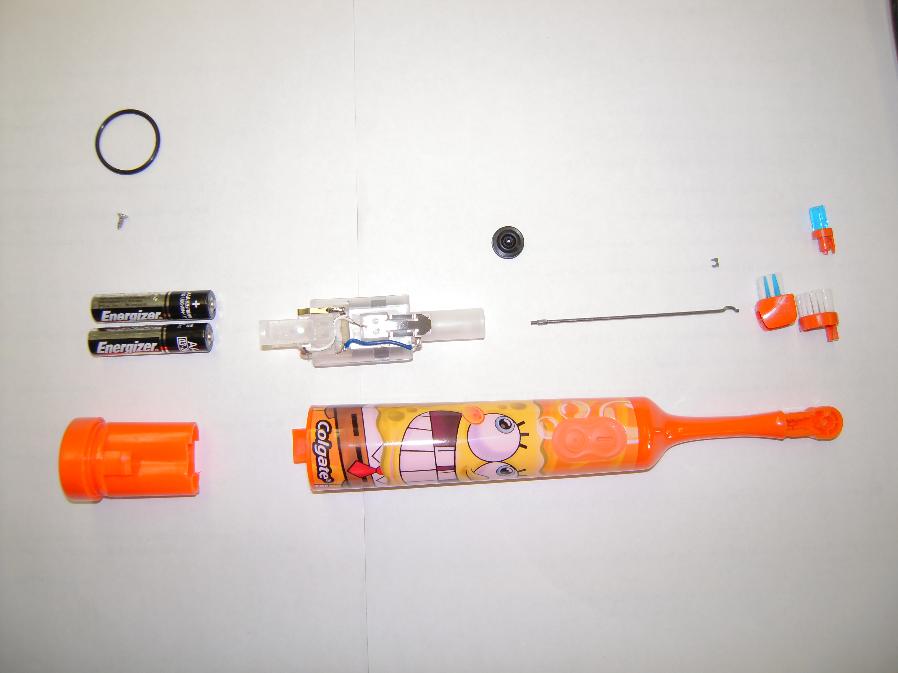
Lab 3 sketch and picture:
|
|
Lab_3_Sketch.pdf Size : 749.366 Kb Type : pdf |
5.3 Benchmarking
Table 2: Benchmarking of Four Products
| Selection Criteria | Weight | Colgate Spongebob | OralB CrossAction | Colgate Motion Whitening | OralB Power Stages | ||||||||
| Rating | Value | Score | Rating | Value | Score | Rating | Value | Score | Rating | Value | Score | ||
| Whiteness | 15% | 2 | 4 | 0.3 | 5 | 7 | 0.75 | 4 | 5 | 0.6 | 3 | 6 | 0.45 |
| Cavity Protection | 20% | 2 | 3 | 0.4 | 4 | 5 | 0.8 | 3 | 4 | 0.6 | 5 | 6 | 1 |
| Selling Price | 13% | 5 | $6.99 | 0.65 | 3 | $8.00 | 0.39 | 4 | 7.49 | 0.52 | 1 | $10.00 | 0.13 |
| Pain | 5% | 2 | 3 | 0.1 | 3 | 5 | 0.15 | 1 | 2 | 0.05 | 5 | 8 | 0.25 |
| Variety of styles | 5% | 2 | 3 | 0.1 | 3 | 4 | 0.15 | 5 | 5 | 0.25 | 3 | 4 | 0.15 |
| Appeal of styles | 10% | 4 | 7 | 0.4 | 5 | 10 | 0.5 | 1 | 4 | 0.1 | 2 | 5 | 0.2 |
| Battery life | 13% | 2 | 4 Hrs | 0.26 | 4 | 10.2 Hrs | 0.52 | 5 | 11 Hrs | 0.65 | 1 | 1.056 Hrs | 0.13 |
| Brush head life | 13% | 3 | 2 Months | 0.39 | 3 | 2 Months | 0.39 | 4 | 3 Months | 0.52 | 1 | 1 Month | 0.13 |
| Sound | 6% | 3 | 74.5 dB | 0.18 | 1 | 80.5 dB | 0.06 | 2 | 76 dB | 0.12 | 5 | 67.3 dB | 0.3 |
| Total | 100% | ||||||||||||
| Total Score | 2.78 | 3.71 | 3.41 | 2.74 | |||||||||
| Rank | 3 | 1 | 2 | 4 | |||||||||
6.0 Target Specification
Using our customer needs analysis we were able to set target specifications with measurable metrics that corresponded to said needs. For each need we created a method and therein a metric by which we could measure the products ability to satisfy that need. We then used these metrics and set marginal and ideal specifications according to both our benchmarking table and the information we gathered from our external research.
Table 3: Target Specifications
| Metric No. | Need No. | Metric | Imp | Units | Marginal Value | Ideal Value |
| 1 | 1 | Whiteness | 4 | subjective | >4 | >7 |
| 2 | 1 | Cavity Protection | 5 | Integer | >3 | >5 |
| 3 | 2 | Selling Price | 3 | $ | >3 | >5 |
| 4 | 3 | Pain | 2 | Subjective | >7 | >8 |
| 5 | 4,7 | Variety of styles | 2 | Integer | >8 | >9 |
| 6 | 4,7 | Appeal of styles | 3 | Subjective | >6 | >9 |
| 7 | 5 | Battery life | 3 | Hours | <0.50 | <0.15 |
| 8 | 5 | Brush head life | 3 | Months | >5 | >7 |
| 9 | 6 | Sound | 2 | dB | <75 | <68 |
7.0 Concept Generation
Through brainstorming sessions our team created the following morphology chart, using our EMS model, in order to inspire new concepts.
EMS Model

Table 4: Morphology Chart

Concepts:
1. Solar--None--Changeable Head
2. Battery--Recorded Music--Paste Dispenser
3. Wind up--Flashing Lights--None
4. Rechargeable Battery--Recorded Music--Plaque Light
5. Wind power--None--Tongue Scraper
6. Rechargeable Battery--LCD Strip--Changeable Head
7. Wind up--Flashing Lights--Tongue Scraper
8. Rechargeable Battery--LCD Strip--Paste Dispenser
8.0 Concept Selection
We found that our most important criteria were power supply, cost, and aesthetic appeal. We realized that as our target market was children the product's aesthetic appeal would play a pivotal role in our customer's decision to purchase our product. Several products were eliminated due to an impractical design (i.e. the LCD feature from the morphology chart) or for simply being irrelevant to our target market (i.e. paste dispenser). We found there was a trade off between power and cost which resulted in several efficient designs being cut simply because they would cost too much.
Table 5: Concept Screening
| Concept Variants | |||||||||
| Selection Criteria | 1 | 2 | 3 | 4 | 5 | 6 | 7 | 8 | 5,6 |
| Aesthetic Appeal | - | 0 | + | 0 | - | + | + | + | - |
| Extra Feature Appeal | 0 | + | - | + | 0 | 0 | 0 | + | 0 |
| Product Cost | + | - | 0 | - | + | - | + | - | - |
| Power Supply | - | 0 | + | + | - | + | + | + | + |
| Sound | + | - | - | 0 | 0 | 0 | - | - | + |
| PLUSES | 2 | 1 | 2 | 2 | 1 | 2 | 3 | 3 | 2 |
| SAMES | 1 | 2 | 1 | 2 | 2 | 2 | 1 | 0 | 1 |
| MINUSES | 2 | 2 | 2 | 1 | 2 | 1 | 1 | 2 | 2 |
| NET | 0 | -1 | 0 | 1 | -1 | 1 | 2 | 1 | 0 |
| RANK | 3 | 4 | 3 | 2 | 4 | 2 | 1 | 2 | 3 |
| CONTINUE? | no | no | no | yes | combine | combine | yes | no | no |
Table 6: Concept Scoring

9.0 Final Specifications
Whiteness would most likely increase by one with our new brush because of the improved bristle pattern. This would also help with cavity protection along with the tongue scraper. Our selling price will be higher because even though we removed the batteries, the wind up will up the cost. The lights will also raise the cost not only because of the light cost but because inventory and production cost. Pain of brushing will be lower because of the state of the art bristle pattern fits teeth better than the straight cut of the original design. There will be more styles of the toothbrush because the original only had two colors but out final design will have more because of different options for lights and colors. Appeal of the styles will be higher because the lights added will be more attractive. Battery life is not applicable because our new design is wind up and does not use batteries. Brush head life is roughly the same but we expect it to be a bit longer because the head movement will undergo less wear and tear. Sound will be a bit larger because the winding up process makes some noise.
Table 7: Final Specifications
| Feature | Current Specifications | New Specifications |
| Whiteness | 4 | 5 |
| Cavity Protection | 3 | 4 |
| Selling Price | $6.99 | >$7.49 |
| Pain | 3 | 2 |
| Variety of styles | 3 | 5 |
| Appeal of styles | 7 | 8 |
| Battery life | 4 Hrs | N/A (Reusable) |
| Brush head life | 2 Months | 3 Months |
| Sound | 74.5 dB | 76 dB |
10.0 Embodiment Design and Final Design Description
In our final design, we made three major changes. First, we added a tongue scraper to the back of the brush head. Second we added four led lights to the sides of the brush. The lights will add to the appeal of our toothbrush to kids. When the brush is turned on, the lights will flash random colors making brushing more fun for children. Thirdly, we added a wind up. This was our major addition. A lever at the bottom of the brush folds in and out allowing children to wind up the toothbrush. A shaft connecting the lever to the brush slides in and out so the lever can fit in the brush flush with the surface. The wind up works by the rotating action charging up a capacitor. After about 30 seconds of winding, the capacitor will be full of charge. Once the switch is turned on, the connection is completed and energy is discharged from the capacitor. Energy mostly goes toward the motor and a little bit goes to the lights. They will be connected in parallel so that in case the lights break, the motor will still work as opposed to a series connection. We project the cost of the brush will be a bit more, around $9.00, because the wind up will raise production costs.


11.0 Conclusions
This project has been a major success and we believe that our innovations are both groundbreaking and completely unparalleled. Our product meets all of our customer needs and does so in an unprecedented manner that manages to be both cost efficient and environmentally sound. Our mechanism is completely sustainable and environmentally friendly, as its design involves no batteries of any kind. We also employ an electrical circuit based in mechanical energy (winding up the wind up is a mechanical process), which is innately environmentally friendly. In addition to these benefits, we found that our design would remain within the cost margin of our prospective buyers, even though it may be somewhat higher that before. Because of the flashing lights and the Spongebob decal we also expect our design to be aesthetically appealing to our target market of children between the ages of 3-10. Even though the power source is not a battery, our better brush design and the power generated by this design will be more than effective enough to clean a child’s teeth well. This brush will be as painless to use as its predecessor; we did not change anything that would affect this aspect of the brush. Our toothbrush will be as durable as its predecessor for largely the same reason. Thus, our design is able to not only meet all of our customer needs, but it does so in an innovative and environmentally safe manner.
12.0 References
"Colgate kids Spongebob Powered Toothbrush." Amazon.com/americarx. amazon.com, Web. 24 Feb 2010. < http://www.amazon.com/Colgate-Sponge-Powered-Toothbrush-Bristles/dp/B0009W7MKU>.
"Colgate Spongebob Powered Toothbrush." drugstore.com. drugstore.com, inc, Web. 24 Feb 2010. < http://www.drugstore.com:80/products/prod.asp?pid=92018&catid=33675>.
Frederic H. Middleton, “Rotary electric toothbrush” US Patent no. 4603448, Issued: Aug 5, 1986
Robert D. Stopher, “Wind-up power source with spring motor and vehicle incorporating same” US Patent no. 5880532, Issued: Mar 9, 1999


